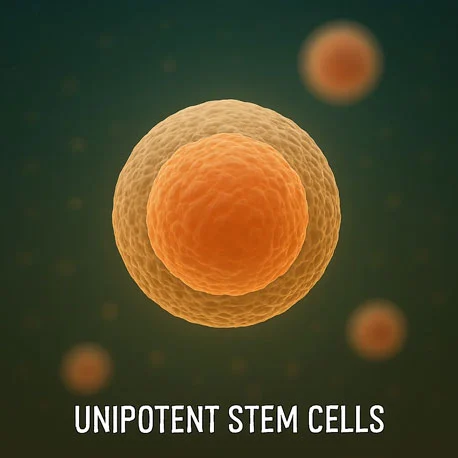
Unipotent stem cells are a specialized type of stem cells that have the ability to self-renew and differentiate into only one specific cell type. While their differentiation potential is more limited compared to other stem cell categories, unipotent stem cells play a vital role in maintaining normal tissue function and continuous cellular renewal in the human body.
The primary function of unipotent stem cells is tissue maintenance and localized repair. These cells are found in various adult tissues and act as a natural replacement system for worn-out or damaged cells. For example, skin stem cells continuously generate new skin cells, muscle stem cells repair muscle fibers after injury, and corneal epithelial stem cells regenerate the outer surface of the eye. This ongoing process allows tissues to remain healthy and functional throughout life.
Unlike totipotent or pluripotent stem cells, unipotent stem cells are already fully committed to a specific cellular lineage. This means they cannot transform into multiple tissue types, but they retain the ability to divide and produce identical copies of their own cell type. This biological specialization makes them stable, predictable, and naturally integrated into normal body processes.
In ophthalmology, unipotent stem cells are particularly important for corneal health. Limbal stem cells, located at the edge of the cornea, are responsible for maintaining corneal transparency and smoothness. These cells continuously regenerate corneal epithelial cells, which are essential for clear vision. Damage or deficiency of limbal stem cells can result in corneal scarring, chronic inflammation, surface irregularities, and significant visual impairment.
From a clinical perspective, unipotent stem cells are mainly used in localized therapies rather than systemic regenerative treatments. One of the most well-established applications is limbal stem cell transplantation for patients with severe ocular surface disorders, such as chemical burns, infections, or traumatic injuries. In these cases, healthy limbal stem cells may be transplanted from the patient’s own eye or from a donor to restore corneal surface integrity.
At Stem Cell Cure India, unipotent stem cells are recognized for their biological importance but are not used for treating complex retinal or optic nerve disorders. Their therapeutic role is limited because they cannot support neural regeneration or multi-tissue repair, which is required in most degenerative eye diseases.
One of the key advantages of unipotent stem cells is safety. Since they are restricted to a single cell type, they do not carry the risk of uncontrolled differentiation or tumor formation. This makes them biologically safe, but their limited flexibility also restricts their application in advanced regenerative medicine.
Unipotent stem cells function more as a maintenance system rather than a regenerative solution. They help preserve normal tissue structure, support healing after minor injuries, and maintain cellular balance. However, they are not capable of reversing degenerative diseases or restoring lost neural function.
In the context of stem cell therapy, it is important for patients to understand that not all stem cells have the same regenerative capacity. Many misconceptions exist where unipotent stem cells are assumed to have similar potential as multipotent or pluripotent cells. In reality, their role is narrow and highly specialized.
At Stem Cell Cure India, patient education is a core part of clinical practice. Clear information is provided about which stem cell types are suitable for therapy and which are primarily involved in natural tissue maintenance. This ensures realistic expectations and informed medical decisions.
Unipotent stem cells represent the body’s natural repair mechanism. While they do not offer broad regenerative potential, they are essential for sustaining everyday tissue health, especially in epithelial and surface structures. Their importance lies in preserving biological stability rather than enabling large-scale tissue regeneration.
They can form only one specific cell type.
They help maintain and repair specific tissues.
They are mainly involved in natural tissue regeneration.


